
Belmont Ghost Town, Nevada’s Best-Preserved Silver Mining Town
Belmont Ghost Town sits far off the main highways in central Nevada’s high desert, roughly 45 miles northeast of Tonopah. The silver mining town thrived for only about 20 years after a rich strike in 1865, yet it left behind one of the state’s most intact reminders of the boom era: the two-story brick Nye County Courthouse. At its height, the town supported stores, saloons, restaurants, a bank, a school, a telegraph office, two newspapers, and a racetrack. Today a handful of year-round residents share the streets with visitors who come to walk among the weathered brick walls and wooden buildings that survive in the dry air.

Belmont’s Silver Boom and Quick Decline
Prospectors found silver ore in 1865 in the area then known as the Philadelphia or Silver Bend district. High-grade surface deposits, some assaying thousands of dollars a ton, drew miners from camps such as Austin and Ione. By 1867, Belmont had grown large enough to take the Nye County seat from Ione. The town quickly added four stores, two saloons, five restaurants, a livery stable, a post office, an assay office, a bank, a school, a telegraph office, two newspapers, and a blacksmith shop. A Chinatown, red-light district, churches, and a racetrack also appeared. Peak population is most reliably estimated at around 2,000 people in the 1870s; higher figures in older accounts were probably exaggerated given the size of Nye County at the time.
Several mills ran steadily, including the Monitor-Belmont, Combination, and others. Estimates of total mineral production range from roughly $4 million (the figure on the state historical marker) to as high as $15 million in 19th-century values, with most output occurring between 1866 and 1887. Local wood, water, rock, and clay let residents build substantial brick and wood-frame buildings rather than the temporary tents and shacks typical of many Nevada camps. The town also earned a rough reputation: saloon brawls, shootings, hangings, and feuds were common.

By the late 1880s, the richest shallow ores were exhausted. Most mines closed by 1890, businesses shut, and residents left for newer strikes. The post office operated from 1867 to 1911 and briefly again from 1915 to 1922. A small revival began in 1914 when a mill was rebuilt to process remaining ore and tailings; activity continued until about 1922. The county seat moved to the newer boomtown of Tonopah in 1905. Unlike many mining camps that were completely stripped and abandoned, Belmont retained a small population. Their presence helped spare many structures from total salvage and vandalism. The entire town site was listed on the National Register of Historic Places in 1972 and is marked by Nevada Historical Marker 138. Elevation is about 7,400 feet.

What to See in Belmont Today
The standout structure is the 1876 Nye County Courthouse, a two-story Italianate brick building completed in time for the nation’s centennial. It served as the seat of county government until 1905. The Friends of the Belmont Courthouse and Nye County now care for the building, which was transferred from state ownership in 2012. It is generally closed except during special events or guided visits arranged through the Friends group; check their website or social channels before you go. Inside, decades of visitors have left carvings and graffiti. One unconfirmed mark is sometimes attributed to Charles Manson, who is said to have been run off by longtime resident Rose Walter in the late 1960s. Whether the story is accurate, it adds another layer to the courthouse’s long afterlife.

Dirty Dick’s Belmont Saloon occupies a building assembled in the 1960s from two early-1900s structures. It is completely off the grid, relying on solar power and water from a spring and well. The saloon is seasonal and keeps irregular hours (often Thursday–Sunday in warmer months, though confirmation via Facebook is wise). It functions as a social center for the few residents and the visitors who make the drive. Cold drinks, conversation, and the simple fact of having reached the middle of nowhere make it a popular stop.

Other remnants include the tall brick chimney of the Monitor-Belmont Mill (its top damaged when Air Force pilots used it for target practice in World War II), ruins of the Combination Mill, stone and brick walls of commercial buildings, and scattered miner cabins. Some structures, including the old Combination Mine office and Belmont Courier newspaper building (sometimes called the Philadelphia House), have seen volunteer restoration efforts. Walking the quiet streets, you can still picture the noise and activity that once filled the valley: stamp mills pounding, wagons hauling ore, and the occasional gunfight. The dry climate and remote location have slowed decay, leaving more standing masonry and wood than in many other Nevada ghost towns.
Getting to Belmont: Tips For Your Visit
From Tonopah, head east on US-6 for roughly 5–7 miles, turn north on State Route 376 for about 13–20 miles, then turn east onto Belmont Road (former Nevada 82) for the final 20-plus miles. The last stretch is a graded dirt road that is usually passable in a regular car when dry; after rain or snow, high clearance is recommended, and side roads can be rougher. There are no services in Belmont—fill the tank, bring food, water, and a spare tire in Tonopah. Cell service is limited: download offline maps. Under good conditions, the drive takes about 45–60 minutes one way. Respect private property, leave gates as you find them, and do not enter unstable ruins or old mine workings.
The town’s isolation and arid climate continue to protect what remains. A small permanent population and ongoing preservation work by groups such as the Friends of the Belmont Courthouse keep Belmont from slipping further into pure abandonment. It is one of the clearer examples of a “living” ghost town in Nevada: enough people remain to watch over the site, yet the streets are quiet enough that you can stand alone in front of the courthouse and hear only the wind.
Nearby Places Worth Adding to Your Trip
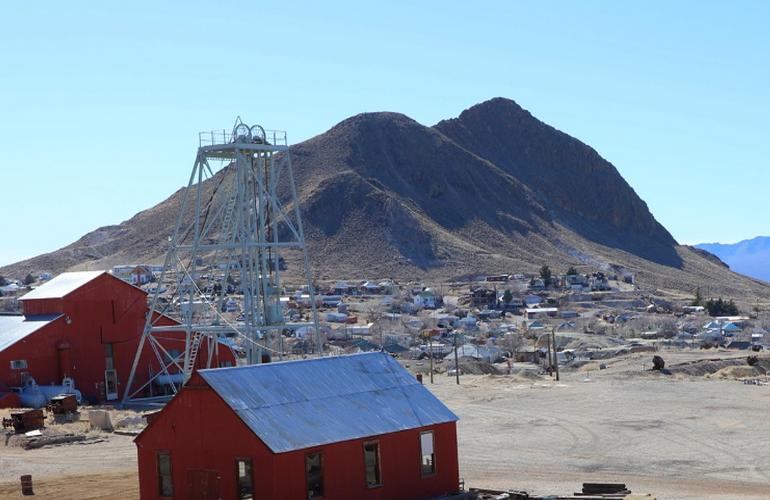
Tonopah is about 45 miles southwest and offers the Tonopah Historic Mining Park, where you can walk the headframes, hoist houses, and mill sites of the early-1900s silver and gold boom that ultimately drew the county seat away from Belmont. Manhattan, a short distance farther north on the same general route, is another partially occupied mining town with its own ruins and a small present-day population. Both make interesting side trips or overnight loops from Tonopah.
Belmont’s story is the classic Nevada mining cycle compressed into a short, intense span: a rich strike, rapid growth into a county seat, mills running around the clock, then the ore playing out and the people moving on. What remains is unusually tangible. The courthouse still dominates the skyline, the mill chimneys still rise above the sage, and a few residents still keep the lights on. For anyone interested in the physical traces of Nevada’s silver era, the long dirt road to Belmont is worth the effort. The quiet streets and standing brick walls give visitors a sense of what a boomtown looked like after the rush ended more than almost any other site in the state.
Nevada Day Trips: Wild West Ghost Towns, Desert Parks & Railroads
Discover more from Daytrippen.com
Subscribe to get the latest posts sent to your email.
As I recall, Charles Manson carved his name in the Belmont Courthouse door jamb in 1969.
I found this in an article from the Las Vegas Review-Journal: