Visiting Salvation Mountain: Hours, History & What to Expect
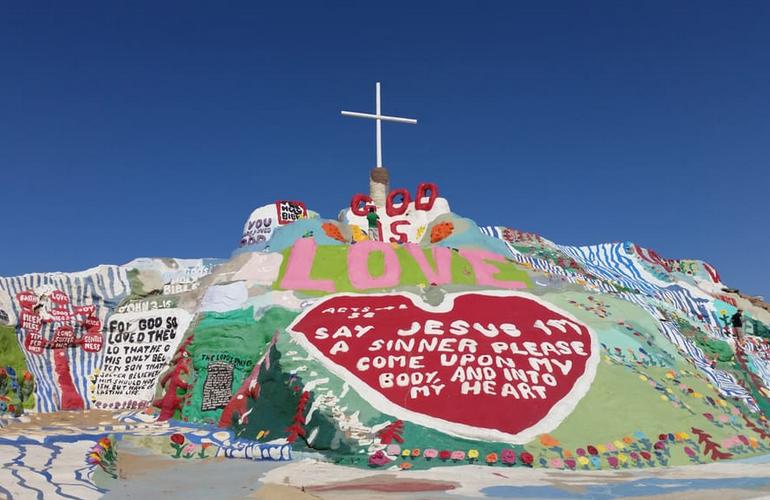
There’s Mt. Sinai, and then there’s Salvation Mountain. On the open desert east of the Salton Sea, a roughly 50-foot-high, 100-to-150-foot-wide adobe structure rises in a blaze of color, covered in religious slogans, flowers, waterfalls, and layer upon layer of donated latex paint. Created by one determined man, Leonard Knight, it stands as one of Imperial County’s most visited free attractions and a striking example of outsider folk art.
Located just east of the small farming town of Niland, this interactive landscape began after Knight’s failed attempt to launch a hot-air balloon made from scraps and bedsheets, carrying the words “God is Love.” The balloon never flew, but the message stayed with him. What started as a modest cement monument in the mid-1980s grew into the mountain visitors see today.

Who Built Salvation Mountain? Leonard Knight’s Story
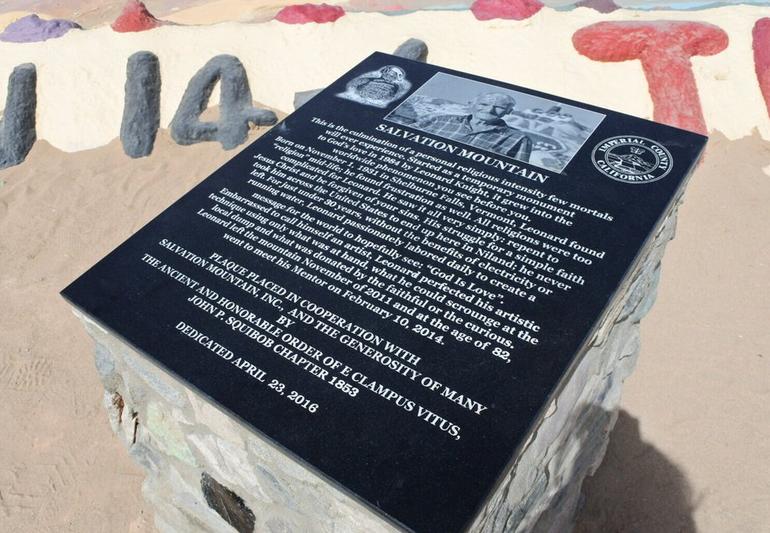
Leonard Knight was born on November 1, 1931, near Burlington, Vermont. He served in the Korean War, later worked as a welder, mechanic, and auto-body painter, and spent years traveling. In the 1970s, he became deeply religious and decided the best way to share his message was a giant balloon that would float high enough for thousands to read “God is Love” and the Sinner’s Prayer.
After years of sewing and failed inflation attempts, Knight arrived in the Slab City area near Niland around 1984–1985 with his truck and the balloon’s remains. He began building a small monument on a desert ledge using cement, sand, and materials scavenged from the dump. The first version grew for several years but collapsed in 1989 after heavy rain and too much sand in the mix. Knight took the failure as a sign to start over with stronger materials. He rebuilt using local adobe clay mixed with straw, discarded tires, hay bales, car parts, windows, and telephone poles. That second mountain stands today.
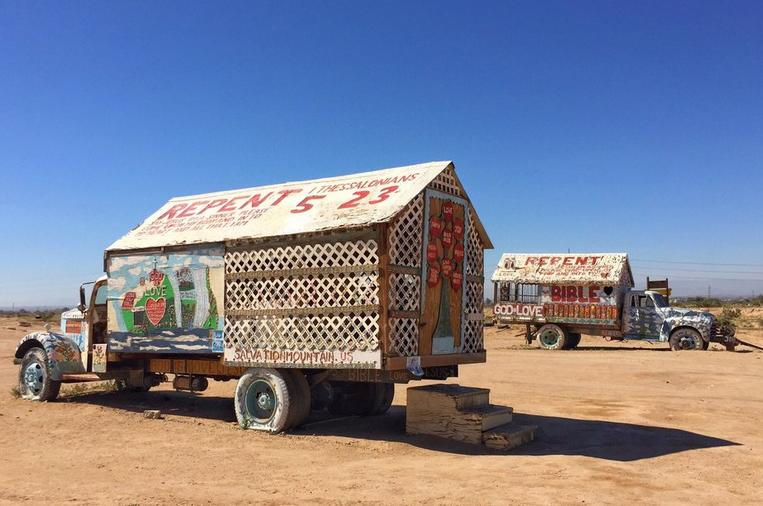
Knight lived for decades in an old Chevy truck steps from the mountain, without electricity or running water. He greeted visitors, gave informal tours, and kept painting. Estimates of the paint used range from more than 100,000 gallons still on the structure to far higher totals applied over the years, almost all of it donated by people who stopped by. The thick layers of latex paint both decorate and help protect the adobe from the harsh desert climate.
At age 80, declining health forced Knight to leave the site in December 2011 for a care facility in El Cajon. He returned once more in May 2013. He died on February 10, 2014, at age 82.
What You’ll See at the Mountain
When you arrive at Salvation Mountain, the first thing that hits you is the color. A large red “God is Love” sits high on the slope above a massive red heart that carries the Sinner’s Prayer: “Say Jesus I’m a sinner please come upon my body and into my heart.” A white cross tops the peak. The surface is covered with painted flowers, trees, waterfalls, birds, and Bible verses. Yellow-brick steps wind upward for views of the surrounding desert.
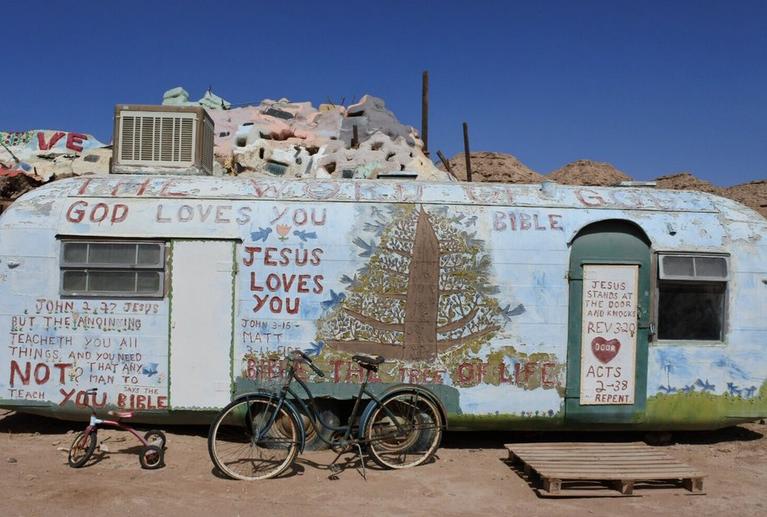
Visitors can also explore the surrounding structures Knight added: adobe hogans (inspired in part by Navajo building styles he observed), a multi-tier museum area, and a partial replica related to the original balloon. Old vehicles painted with messages sit nearby. The site is not an engineered building; it has some tunnels and interior rooms, but the structure is handmade adobe. Walk carefully, watch your footing, and stay on stable surfaces.
The Folk Art Society of America recognized the site as worthy of preservation in 2000. In 2002, Senator Barbara Boxer entered it into the Congressional Record, calling it “a national treasure… profoundly strange and beautifully accessible.” In January 2024, Imperial County designated it a historically significant property and local historical resource, adding another layer of recognition and protection.
Visiting Information and Tips
Salvation Mountain is free and open from sunrise to sunset, 365 days a year. There is no admission fee. A donation box is on site; electronic donations are also accepted through the nonprofit. Do not hand cash to individuals at the site. Address: 603 Beal Road, Niland, CA 92257. Phone: (760) 624-8754. Website: salvationmountain.org (check the open/closed status before you go).
The mountain has no fuel, water, shade, food, or restrooms. Fill your tank in Niland or earlier (services are limited). Bring more water than you think you need, sunscreen, a hat, closed-toe shoes with good grip, and snacks. The last stretch of Beal Road is rough in places. Pets must be leashed. No camping is allowed on the mountain itself (Slab City nearby is free and open). Volunteers help maintain the site and may be available to share information.
The best time to visit is October through April, when temperatures are more manageable. Summer in the Imperial Valley routinely exceeds 110°F with almost no shade. Early morning or late afternoon offers better light for photos and cooler conditions.
Nearby Side Trips
Getting to Salvation Mountain is part of the experience. From Niland, you head east on Beal Road past the edge of Slab City, the long-running off-grid community on the foundations of a former WWII Marine base. Many residents and seasonal visitors live in RVs and trailers. Nearby, East Jesus is an open-air art garden built from recycled materials.
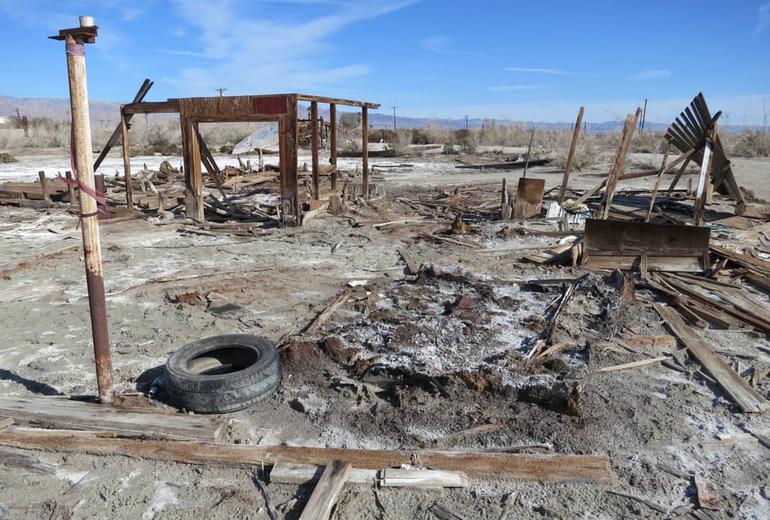
On the way there or back, Bombay Beach on the Salton Sea offers a stark contrast: abandoned structures, half-buried vehicles, and a shoreline of fish bones that feels post-apocalyptic. The Salton Sea itself has a complicated history as a once-popular resort area that has declined as the lake has shrunk and grown saltier.
The Mountain Today and Looking Ahead
Knight refused offers that would have altered his simple message of love, and the mountain remains as he built it. After he left, volunteers and the nonprofit Salvation Mountain, Inc. (a 501(c)(3) formed in 2011) took over maintenance. The desert sun, wind, and occasional rain require constant repainting and repair. The organization has called for paint donations and “Paint Ambassadors” to help collect usable latex paint. The land is state-owned; the nonprofit has worked toward securing the site’s long-term future.
The mountain appeared in the 2007 film Into the Wild and has appeared in documentaries, music videos, and countless photographs. It continues to draw people of all backgrounds—religious or not—who come for the color, the story of one man’s decades-long project, and the place’s sheer improbability.
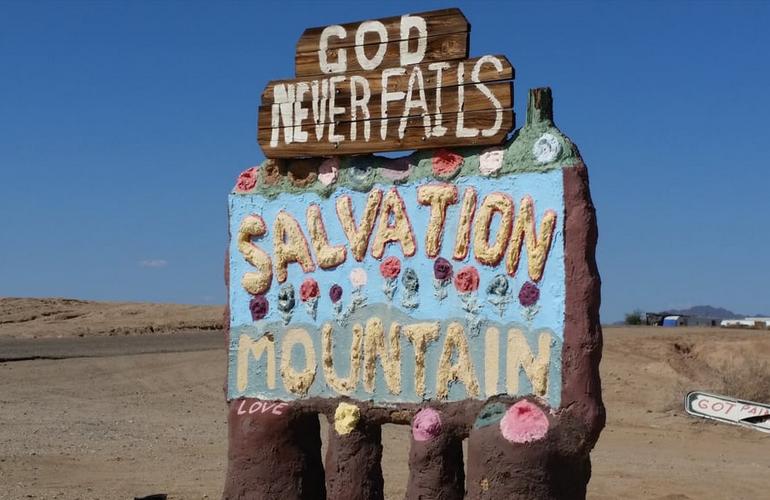
Whether you arrive from San Diego (roughly two hours), Los Angeles (about three hours), or Palm Springs (around 1.5 hours), Salvation Mountain rewards the drive. It is free, open daily, and still one of the most distinctive folk-art stops in Southern California. Bring water, respect the artwork, and take time to walk the yellow brick path and read the messages painted across the adobe. The mountain remains open to visitors, maintained by people who believe Knight’s work is worth preserving for years to come.
Unusual Things to Do in Southern California: Offbeat Destinations
Discover more from Daytrippen.com
Subscribe to get the latest posts sent to your email.