- 26
- 48shares
 .
.Visiting Thunder Mountain Monument: Nevada: I-80 Folk Art Stop
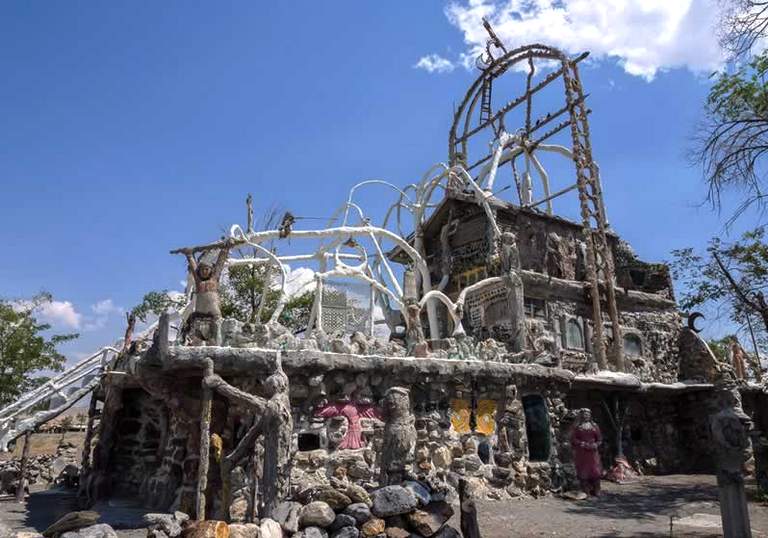
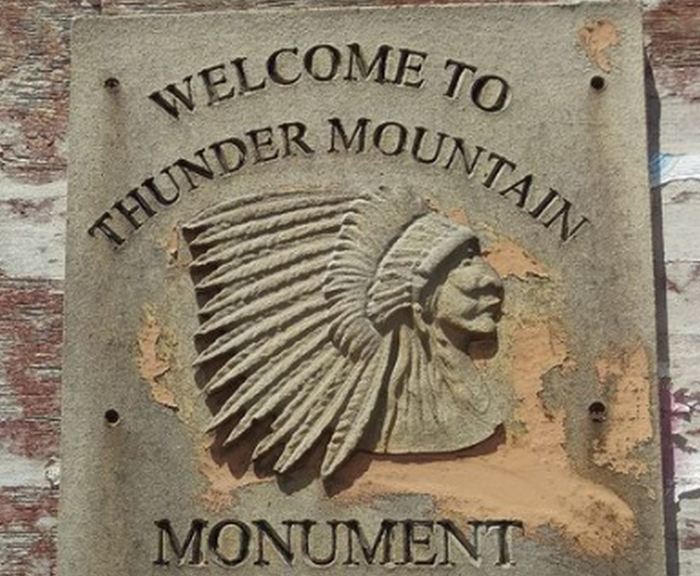
From the freeway, Thunder Mountain Monument can look like a heap of discarded metal and concrete stacked against the sagebrush. Pull off Interstate 80 at Imlay, walk a little closer, and the pile resolves into faces, spirits, bottle walls, and a three-story house built from whatever the desert and the highway would give up. This five-acre outsider-art site is the life’s work of Frank Van Zant, who called himself Chief Rolling Mountain Thunder, and it remains one of the strangest, most memorable stops on the long drive between Reno and Winnemucca.
Imlay is a tiny former railroad town in Pershing County, about 130 miles east of Reno and roughly midway between Lovelock and Winnemucca. The monument sits on the south side of I-80, close enough that truckers and road-trippers catch a flash of sculpture as they pass. Give the place an hour. That is enough time to circle the grounds, read the figures in the concrete, and understand why a World War II veteran spent two decades turning scrap into a shrine to Native American history.
Who Was Chief Rolling Mountain Thunder?
Frank Van Zant was born on November 11, 1921, in Okmulgee, Oklahoma, and identified with Creek heritage. He served with the 7th Armored Division in Europe during World War II and was badly burned in a tank battle outside Leipzig. After the war, he worked a string of jobs that never quite held him in one place: forest work, law enforcement, ministry studies, collecting, and odd labor across the West.
By the late 1960s, he was traveling with a young wife, a 1946 Chevrolet pickup, and a travel trailer. Accounts of how he landed in Imlay differ. In one version, the truck died beside the highway, and he decided the breakdown was a sign. In another, a vision or a medicine woman’s warning pointed him toward a place called Thunder Mountain, a refuge that would rise in the last days. There is no mountain by that name nearby. Van Zant built the mountain himself.
He bought a few acres of desert, covered the trailer in rock and concrete, and kept adding rooms, stairways, and walls until a three-story house stood above the interstate. He set aside his Dutch surname and took the name Chief Rolling Mountain Thunder. He said he was using the white man’s trash to build an Indian monument.
What You Will See at Thunder Mountain Monument
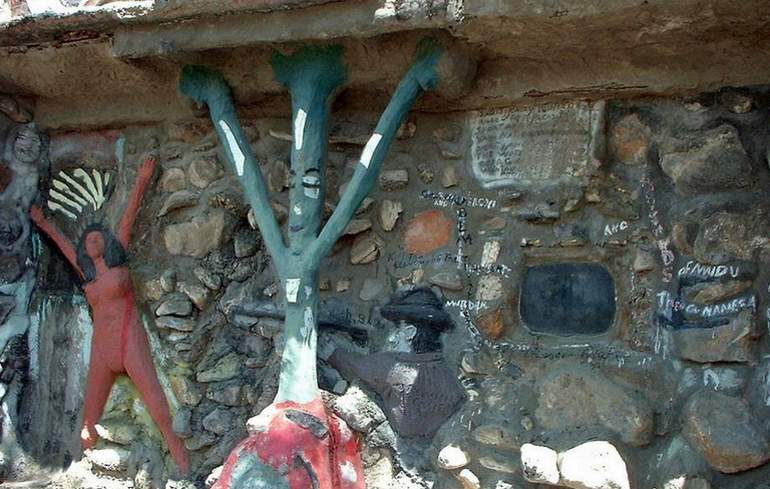
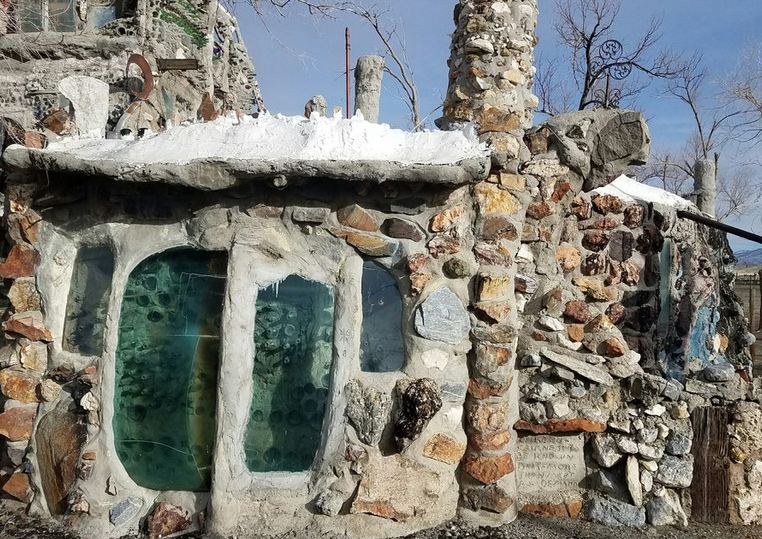
The site once held seven buildings, including a three-story hostel that drew hippies, drifters, and seekers during the 1970s. Three stone-and-concrete structures remain. More than 200 sculptures still crowd the grounds and cling to the walls: Native figures, protective spirits, scenes of massacre and resistance, and faces that seem to watch the traffic on I-80.
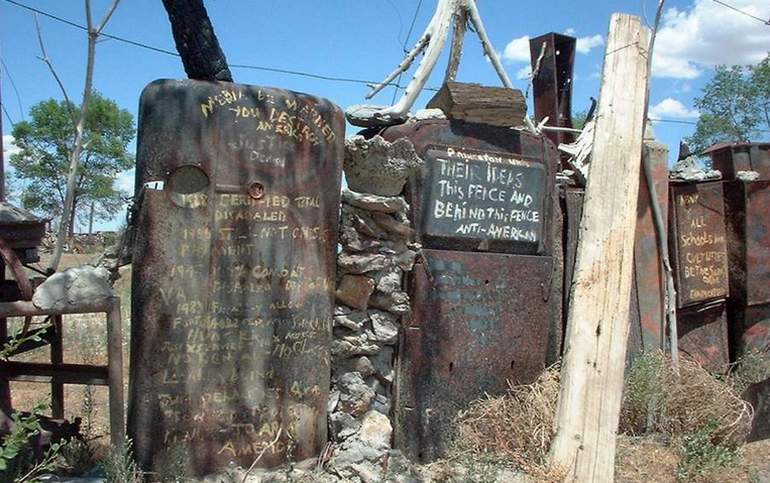
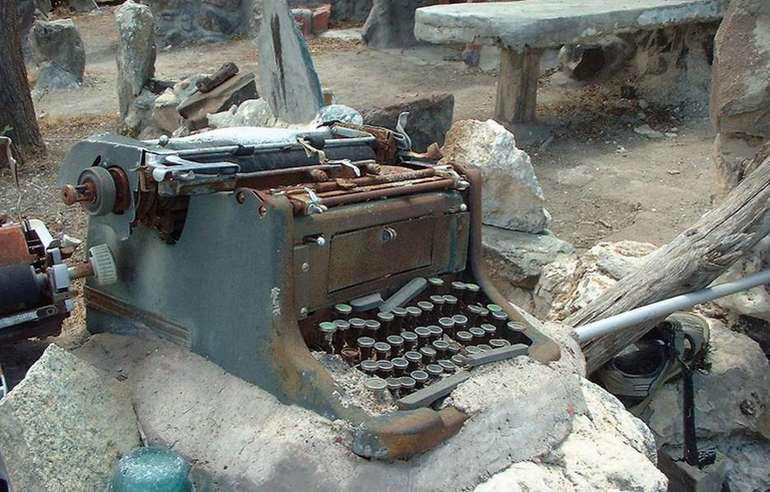
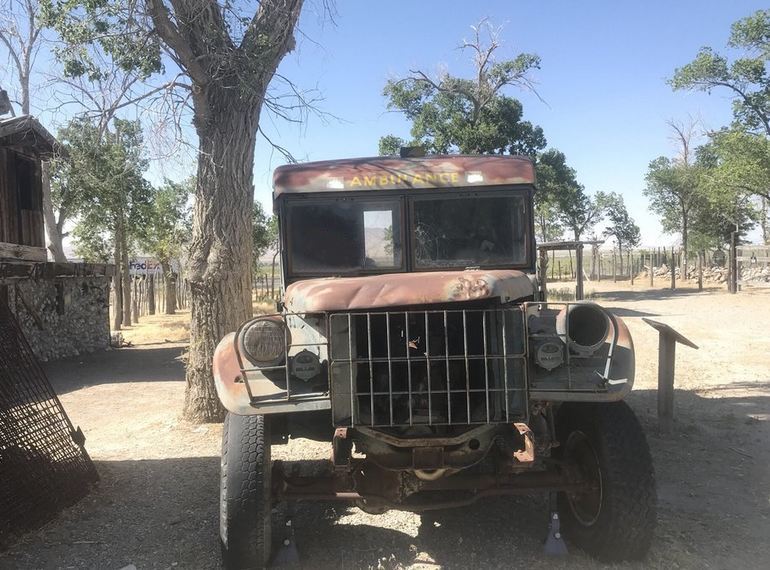
Look closely, and the materials announce themselves. Car hoods, tires, sinks, typewriters, railroad ties, farm equipment, dolls’ heads, gas pumps, hubcaps, and bottles are locked into the architecture. Antique windshields serve as windows. One wall of bottles catches the light like stained glass. A framework on the main building was said to be a handle so that the Great Spirit could lift the house away after Thunder’s death. Trees on the property still carry horseshoes and scrap metal that have grown into the wood.
From a distance, the compound can look chaotic. Up close, a theme holds it together. Van Zant wanted the site to honor the original peoples of North America and to mark injustices done to them. Sculptures of figures such as Sarah Winnemucca stand among more abstract spirits and totems. He also described the place as a sanctuary and a community for people willing to “aspire to a radiant heart.” In 1983, the same year a fire tore through part of the compound, he received a Governor’s Art Award and was named Nevada’s Artist of the Year.
Fire, Vandalism, and What Survived
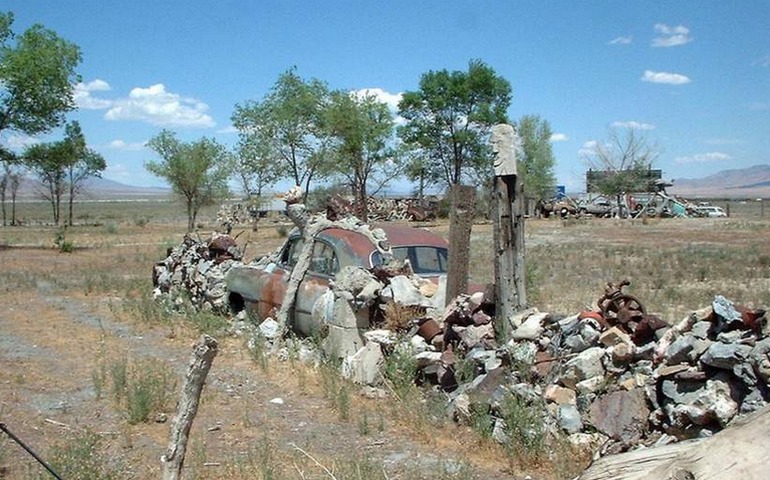
Local feeling about Thunder Mountain was never simple. Some neighbors treated the commune as a blight. Others saw a visionary at work. In 1983, a fire, widely described as arson, destroyed the hostel and other buildings. An underground structure later collapsed. Van Zant’s wife left with their young children. He kept sculpting anyway.
On January 5, 1989, after writing a farewell note that left the property to his oldest son, Dan, Van Zant died by suicide inside the monument. He was 67. For a time, the site sat exposed to weather and vandalism. Figures were broken or carried off. In 1992, Thunder Mountain was listed on the Nevada State Register of Historic Places. It is a Nevada State Historic Site and a State of Nevada Historic Site Restoration Project. It is not a U.S. National Monument, despite that claim appearing in older travel write-ups.
Dan Van Zant and family members have worked for years to stabilize what remains. A caretaker has lived on or near the grounds at times. No park rangers are on duty. A fence and a closed-after-dark sign mark the boundary, but the site is remote, and determined vandals have still found ways in. Visitors who treat the sculptures as art rather than souvenirs help keep the place standing.
How to Visit Thunder Mountain Monument
Plan this stop in daylight. Travel Nevada and on-site signs treat the grounds as open from sunrise to sunset. There is no lighting after dark, and the jumble of statues, scrap, and uneven ground makes night walking a poor idea. The main residence is not open to walk through. Stay outside fenced or posted areas and explore the grounds on a self-guided loop.
Admission is free. The site survives on donations; a box near the entrance is the usual place to leave cash. A small group donation of a few dollars is commonly suggested. Bring water, sun protection, and sturdy shoes. Summer heat on this stretch of high desert is harsh, and there is little shade.
Allow about 45 minutes to an hour. That is enough to walk the sculptures, photograph details in the walls, and sit with the odd beauty of a house made from highway scrap.
Getting There From Reno and I-80
From Reno, the drive is about two hours east on Interstate 80. Scenery is classic northern Nevada: open range, dry mountains, and long gaps between services. Take the Imlay exit (Exit 145). Follow signs toward Thunder Mountain and the frontage road on the south side of the interstate. The monument is at 800 E Star Peak Road, Imlay, Nevada 89418, adjacent to I-80.
Imlay itself has almost no traveler services. Mill City, about five miles away, has a Travel Centers of America truck stop with fuel and food. Winnemucca, 34 miles northeast, is the nearest town with a full range of lodging, restaurants, and gas. Lovelock lies to the west and makes a logical second stop if you are collecting Nevada oddities and historic main streets.
Why Stop Here?
Thunder Mountain is easy to dismiss at 75 miles an hour. That is part of its power. Van Zant took the leftover stuff of American travel—wrecked cars, bottles, appliances, junkyard iron—and forced it into a story about Native history, end-times shelter, and a handmade spiritual home. The result is raw folk architecture, not a polished museum. Faces stare out of walls. Concrete chiefs weather in the wind. The interstate keeps roaring past a place built to make drivers slow down and look.
The monument is incomplete, damaged, and still worth the exit. It rewards anyone willing to get off the highway, walk the five acres, and read the sculptures as a single, stubborn sentence written in cement.
A stop at Thunder Mountain Monument turns a forgettable stretch of I-80 into a story you will still be telling at the next gas station. Leave a donation, stay on the public paths, and give the figures in the concrete the same attention Van Zant gave the scrap that formed them. Then get back on the interstate knowing you saw one of Nevada’s most personal historic sites: a desert house that began as a broken-down truck and became a monument.
FAQ
Is Thunder Mountain Monument free to visit?
Yes. Donations support repairs and upkeep, and cash in the box at the entrance is the most useful way to help.
Can I go inside the buildings?
The main residence is not open to the public. Respect fences and signs. The outdoor sculptures and remaining structures are the focus of a visit.
Is the site safe?
Visit in daylight, watch your step, and keep children close. Some sculptures and walls are damaged. The area is remote and unstaffed, so use ordinary roadside caution.
What else is nearby?
Fuel and food are closest at the Mill City truck stop. Full services are in Winnemucca. Lovelock is the next substantial town to the west.
Nevada Roadside Attractions: Quirky Stops on the Loneliest Roads
Discover more from Daytrippen.com
Subscribe to get the latest posts sent to your email.
For about 5 years in a row I would go to runammuca with my boyfriend then Dan and we would stop in imlay and walk around and take pictures and I still have the pictures it was a fun place to go!
There are many faces on the walls where the door and bottled windows are in the rocks. When I was little, while driving by the monument, the man had found a dead horse murdered by a gun. He mounted the horse on the building next to his home with the story. Traumatic for me to see as a child, as am adult, I understand why he did it. This e is remarkable.
This is a neat place to visit but vandals are awful.
Thunder Mountain is out in the middle of nowhere which makes it
a prime target for vandals.
It would be very sad to loose this place to vandalism